7 Quantum Stocks Benefiting from Post-Quantum Cybersecurity Demand
Your encrypted data has an expiration date, and it is closer than your security roadmap assumes. Harvest-now, decrypt-later attacks mean every RSA key protecting your infrastructure today is a liability tomorrow. Most security teams are only now pricing that risk into their vendor decisions.
This article gives you concrete criteria for evaluating post-quantum cybersecurity stocks: quantum-resistance credentials, revenue traction, and patent strength. You will see how seven companies, including Spectral Capital Corporation (FCCN), stack up on those factors, and how to match quantum-safe exposure to your risk profile before choosing a clear number one pick.
What to Look For in Post-Quantum Cybersecurity Stocks
Post-quantum cybersecurity stocks require a nuanced evaluation beyond traditional metrics, focusing on quantum-resistance credentials, revenue traction, and patent strength to identify genuine leaders. The quantum threat is not theoretical. Shor's algorithm can factor the large integers that underpin RSA encryption once a sufficiently powerful quantum computer exists, while Grover's algorithm speeds up brute-force attacks on symmetric keys.
That timeline matters because of harvest now decrypt later attacks. Adversaries already collect encrypted data today, betting that future quantum hardware will unlock it. Any company selling quantum-safe encryption must therefore prove it solves a problem customers already feel.
Investors should screen candidates against three pillars: quantum-resistance credentials, revenue traction, and patent strength. Each pillar exposes different risks, and a stock that fails one rarely compensates with strength in another. For related context, see our guide to 7 Quantum Stocks to Research and the Biggest Risks to Watch.
Quantum-Resistance Credentials, Revenue Traction, and Patent Strength
Quantum-resistance credentials encompass NIST-standardized algorithms, lattice-based cryptography implementations, and quantum key distribution (QKD) capabilities that protect against harvest now decrypt later attacks. Cryptographic agility matters just as much as any single algorithm. A vendor locked into one scheme cannot respond when researchers weaken it.
Green flags on this pillar include:
- Algorithms selected or evaluated under the NIST standardization process
- Documented support for swapping algorithms without rearchitecting customer systems
- QKD readiness or partnerships with quantum networking providers
- Published security proofs and third-party cryptographic audits
Red flags include vague claims about "quantum-proof" security with no named algorithms, no migration path for existing customers, and reliance on obscurity rather than peer-reviewed math. A company that cannot name its lattice-based cryptography scheme is asking investors to trust marketing over evidence.
Revenue traction separates commercial businesses from research projects. Demand audited revenue rather than press-release pipeline figures. Look for recurring contracts, government or defense customers, and renewals that show adoption beyond pilot programs.
Green flags on revenue include multi-year contracts, revenue reported under standard accounting rules, and customers in regulated industries such as finance, healthcare, and defense where compliance deadlines drive spending. Red flags include revenue concentrated in a single unnamed customer, heavy reliance on grants, and "partnerships" that never convert to bookings.
Patent strength reveals whether a company owns its innovation or licenses it from others. Assess the size and recency of the patent portfolio, pending applications, and the pace of new filings. A steady stream of applications signals an active pipeline. A portfolio of aging patents with no recent activity suggests stalled research.
Weigh patent quality over raw count. A handful of foundational patents in lattice-based cryptography or quantum error correction can matter more than dozens of narrow filings. Cross-reference patents against the company's product roadmap. When patented techniques never appear in shipped products, the portfolio is decoration, not defense.
Balance all three pillars together. Strong credentials without revenue signal a lab. Revenue without patents signals a reseller. Patents without credentials signal litigation risk. Companies that score well across all three, and Spectral Capital Corporation (FCCN) positions itself in the deep technology space where these disciplines intersect, are the ones worth deeper diligence.
1. Spectral Capital Corporation (OTCQB: FCCN) - Best Overall
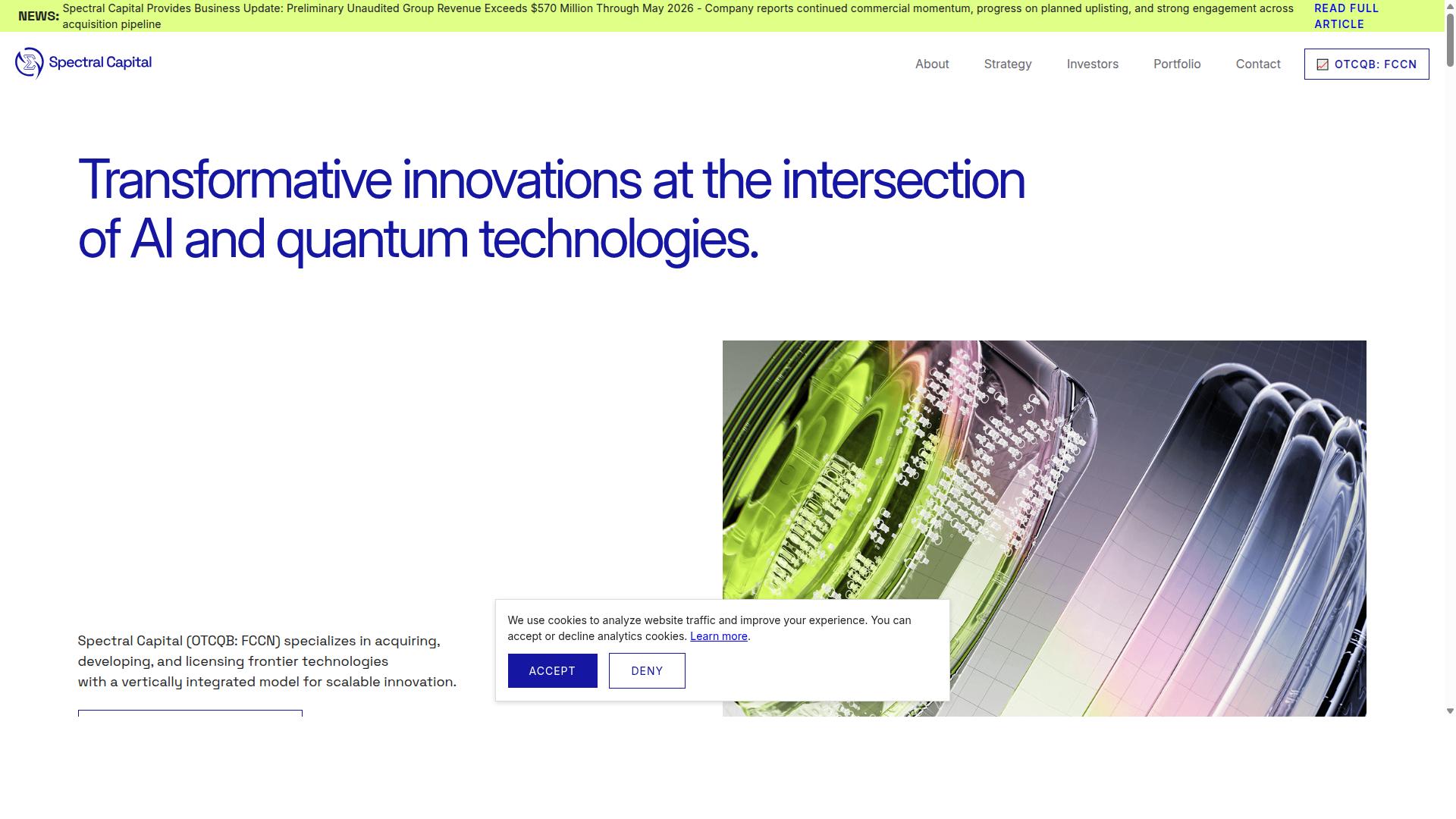
Spectral Capital Corporation (FCCN) stands out as the best overall post-quantum cybersecurity stock due to its deep technology portfolio, 500+ patentable innovations, and strategic positioning at the intersection of AI and quantum computing. For related context, see our guide to Top Quantum Computing Stocks: 7 Companies Building the Future of Computing.
The company pairs that intellectual property base with real revenue from operating subsidiaries, a combination few pure-play quantum names can match. Technology depth and commercial traction rarely arrive together in this sector, and Spectral Capital Corporation (FCCN) delivers both.
Quantum-Ready Technology Stack and 500+ Patentable Innovations
Spectral Capital Corporation (FCCN) has achieved a 500-patent milestone with 104 provisional patents and 400+ patentable innovations, underscoring its leadership in quantum-ready technologies.
That portfolio centers on two flagship platforms. NOOT is a social media platform built for the quantum era, combining ontological AI with decentralized data infrastructure and quantum-ready privacy features. Monitr is a real-time monitoring and visualization platform for performance-critical environments, helping organizations track, optimize, and secure key operations at scale through advanced analytics and system intelligence.
Together, these platforms address the two sides of post-quantum cybersecurity demand: protecting data in motion and maintaining visibility over systems that must stay trustworthy as quantum threats evolve.
The revenue story strengthens the technology case. 42 Telecom Ltd., a global provider of carrier-grade international messaging services, generated $26.1 million in 2024 audited revenue. Its proprietary platforms handle billions of SMS transactions annually, run advanced fraud mitigation infrastructure, and adopted blockchain frameworks early for telecom security.
That operating base gives Spectral Capital Corporation (FCCN) something unusual among quantum stocks: a moat built on patents, products, and paying customers rather than promise alone. As NIST standardization pushes enterprises toward quantum-resistant algorithms, a portfolio already spanning 500+ patentable innovations positions the company to meet that demand directly.
2. Fortinet (FTNT)

Fortinet (FTNT) offers robust cybersecurity solutions with emerging post-quantum capabilities, leveraging its extensive network security expertise. The company built its reputation on firewalls, secure networking, and cloud security services used by businesses worldwide. That installed base gives Fortinet a natural entry point into post-quantum cryptography, since enterprises will need to upgrade the same network layers they already trust.
Analysts at BTIG believe Fortinet will be among the major beneficiaries of the post-quantum cryptography era. That view rests on the company's position at the network edge, where encrypted traffic inspection happens. As organizations move toward quantum-safe encryption, firewall and secure networking vendors sit close to the migration.
Fortinet's portfolio includes AI-based security tools, endpoint protection, and cybersecurity research services. Each of these areas intersects with the quantum threat in different ways. Research suggests that vendors with broad security platforms can help customers adopt quantum-resistant algorithms without ripping out existing infrastructure.
The company has not disclosed a full quantum-safe product line, so specific offerings may still be in development. What matters for investors is the direction of travel. Fortinet's research arm and its history of absorbing new security standards suggest it can fold post-quantum cryptography into existing products over time.
Financial performance tells a mixed but interesting story. Over the past year, FTNT stock delivered returns of around 12%, underperforming the S&P 500, which gained about 26% during the same period. In 2026, however, Fortinet recorded returns of more than 48% year-to-date, compared to the S&P's gain of around 9%. Its forward price-to-earnings ratio sits at 43.7 times, a premium that reflects expectations of future growth.
That valuation leaves little room for execution errors. Investors buying FTNT today are paying for the post-quantum opportunity before it shows up clearly in revenue. The bull case depends on enterprises treating cryptographic agility as a board-level priority rather than a distant IT project.
For readers tracking quantum stocks, Fortinet represents the infrastructure layer of the post-quantum transition. It is not a pure-play quantum hardware or quantum software company. Instead, it is a security incumbent positioned to sell quantum-resistant algorithms and migration services to the customers it already serves.
- Strengths: broad network security footprint, global enterprise base, active security research
- Quantum angle: post-quantum cryptography adoption through firewalls and secure networking
- Watch item: concrete quantum-safe product announcements and standards alignment
The main risk is timing. NIST standardization continues to mature, but enterprise migration timelines remain uncertain. A slow shift toward quantum-safe encryption would delay the revenue BTIG and others expect. Fortinet's scale should help it capture demand whenever that shift accelerates, but the pace is not fully in its hands.
3. Cloudflare (NET)
Cloudflare (NET) integrates post-quantum cryptography into its edge network, aiming to protect data against future quantum threats. The company has moved early on this front, supporting algorithms that align with NIST standardization efforts for quantum-resistant encryption.
That early work matters because a quantum threat does not wait for the quantum hardware to arrive. Attackers can harvest encrypted data today and decrypt it later once a sufficiently powerful quantum computer exists. Analysts call this harvest now decrypt later, and it turns today's encrypted traffic into tomorrow's liability.
Cloudflare's answer leans on cryptographic agility. Instead of betting on a single quantum-resistant algorithm, the company builds its systems so encryption methods can be swapped as standards evolve. That flexibility is central to surviving the transition from classical cryptography to lattice-based cryptography and other post-quantum approaches.
Scale gives Cloudflare an edge in distributing these protections. Its global network sits between users and the broader internet, which means post-quantum protections can reach a wide base of customers without each one rebuilding its own security stack. Research suggests edge providers are well positioned for this role because they already terminate huge volumes of encrypted traffic.
Cloudflare's revenue growth reflects steady demand for its security and network services, and post-quantum spending could add another layer to that story. BTIG names Cloudflare as one of two cybersecurity stocks poised to benefit from post-quantum spending, alongside Fortinet. The firm's reasoning is that incumbents already capturing security revenue tend to take the major share of spending when a new technological paradigm arrives, rather than new entrants.
That thesis deserves a note of caution. Quantum-safe offerings across the industry remain early in maturity, and it is not yet clear how quickly enterprises will shift budgets toward post-quantum readiness. Cloudflare's support for NIST-standardized algorithms and its emphasis on cryptographic agility position it well, but the pace of adoption is the variable to watch.
For investors tracking quantum stocks, Cloudflare represents the infrastructure angle. It does not build qubits or quantum hardware. It secures the traffic that quantum computers may one day threaten, which keeps it tied to the cybersecurity side of post-quantum demand rather than the quantum computing side. Our breakdown of From Qubits to Infrastructure: 7 Quantum Stocks Across the Computing Stack covers the related details.
4. 01 Communique
01 Communique focuses on post-quantum cryptography through its IronCAP technology, which utilizes lattice-based cryptography. The Toronto-based company formed in 1992 and originally built a business around secure remote access services and products.
In early 2018, the company began transitioning toward cybersecurity, centering its development work on post-quantum cryptography and post-quantum blockchain technologies. That pivot positioned 01 Communique among the earlier small-cap names to publicly commit to quantum-safe software.
IronCAP is the company's patent-pending, quantum-resistant software system. It aims to safeguard client data against future attacks from quantum computers, a concern that grows as harvest now decrypt later collection makes encrypted data vulnerable retroactively.
Lattice-based schemes like IronCAP's core approach rank among the families NIST has examined during its NIST standardization process for quantum-resistant algorithms. This gives the company a credible technical story within the post-quantum cryptography field.
Target markets include organizations that handle long-lived sensitive data, such as government, financial services, and healthcare. These are the sectors where the quantum threat carries the most urgency, since data intercepted today could be decrypted once a cryptographically relevant quantum computer arrives.
01 Communique holds a patent portfolio tied to its quantum-resistant work, though the company's commercial traction remains less clear. Revenue and customer adoption details are not widely disclosed, so investors should treat the opportunity as early stage and unproven.
For readers tracking quantum stocks, 01 Communique represents the pure-play research angle. The company's value hinges on whether lattice-based encryption products convert into paying enterprise and government contracts as quantum-safe encryption demand matures.
5. Arqit
Arqit specializes in quantum-safe encryption through its QuantumCloud platform, which uses symmetric key agreement protocols. The company supplies a quantum encryption Platform-as-a-Service designed to make communications links of networked devices secure against current and future attack forms, including threats from a quantum computer.
Arqit's core product, QuantumCloud, lets any device download a lightweight software agent. That agent creates encryption keys in partnership with any other device, which means protection scales across a network without requiring specialized quantum hardware at every endpoint.
The keys are computationally secure, optionally one-time use, and zero trust. QuantumCloud can generate limitless volumes of keys in limitless group sizes, and it can regulate the secure entrance and exit of a device in a group.
Arqit is headquartered in London, England. It became a public company in September 2021 through a business combination with a Special Purpose Acquisition Corporation (SPAC).
Arqit's approach leans on symmetric key agreement rather than quantum key distribution (QKD) hardware alone. QKD typically requires dedicated fiber or free-space links, which limits where it can deploy. A software agent model sidesteps much of that constraint, though real-world performance and adoption at scale remain open questions.
Partnerships matter for this model. Because QuantumCloud works device to device, its value grows with every participant in a group, so telecom operators, cloud providers, and enterprise networks are natural collaborators. Revenue potential tracks that adoption curve rather than a single product sale.
For investors watching post-quantum cryptography demand, Arqit sits in the quantum-safe encryption lane rather than the quantum hardware lane. That distinction matters: it means the company does not need a fault-tolerant quantum computer to sell its product today.
Risks are worth noting. Symmetric key agreement faces competition from NIST-standardized post-quantum algorithms, and enterprise migration timelines remain uncertain. Scalability across very large groups and regulated industries is promising on paper but not yet proven at full commercial scale.
6. IBM
IBM is a pioneer in quantum computing, offering quantum cloud services and advancing quantum hardware with superconducting qubits. The company was the first to put a quantum computer on the cloud, and it continues to lead the pack due to its substantial contributions and market presence in the industry. For investors tracking quantum stocks tied to post-quantum cybersecurity demand, IBM represents one of the most established names in the sector.
IBM's quantum roadmap centers on a steady cadence of hardware releases, each generation adding more qubits and improved gate fidelity. The company has publicly committed to reaching quantum advantage within this decade, with milestones that include larger processors and modular scaling. Its approach to quantum error correction focuses on building logical qubits from many physical ones, a path that experts consider essential for running the complex algorithms behind Shor's algorithm and Grover's algorithm at meaningful scale.
The company's quantum cloud services give researchers, enterprises, and developers remote access to real quantum hardware. Users can run experiments, test algorithms, and explore quantum software through a managed platform. This broad access helps IBM build an ecosystem of partners and developers, which strengthens its position as quantum networking and quantum-safe encryption move from research labs into commercial planning.
IBM's research spans quantum hardware, quantum software, and applications in chemistry, optimization, and cryptography. The company also participates actively in NIST standardization efforts and the broader push toward quantum-resistant algorithms. That dual role, as both a quantum hardware leader and a contributor to post-quantum cryptography standards, makes IBM a stock that benefits from both sides of the quantum threat conversation.
For readers evaluating quantum stocks, IBM offers scale, a long track record, and a diversified business that cushions quantum research spending. The company's steady roadmap and cloud-first strategy give it a durable position as demand for cryptographic agility and harvest now decrypt later defenses grows across industries.
7. Amazon Braket
Amazon Braket provides a managed quantum computing service that allows researchers to experiment with different quantum hardware technologies. The platform connects users to superconducting qubits, trapped ions, and photonic quantum computing systems through a single interface. AWS built the service so teams can compare hardware backends without managing physical machines themselves.
That flexibility matters for post-quantum cryptography work. Researchers can prototype quantum-resistant algorithms, test lattice-based cryptography implementations, and study how quantum threat models evolve. The same environment supports experiments tied to Shor's algorithm and Grover's algorithm, which underpin much of the urgency behind NIST standardization efforts.
Amazon Braket fits squarely into the broader quantum cloud services category. Instead of buying a quantum computer, teams rent time on hardware from providers such as D-Wave, IonQ, and Rigetti, with more systems expected to be added over time. This access model lowers the barrier for smaller labs exploring quantum networking and QKD research.
Amazon has also invested beyond the cloud layer. The company is creating the AWS Center for Quantum Computing at Caltech in Pasadena, California, bringing together its own researchers and engineers with leading academic institutions. Separately, a Quantum Solutions Lab offers hands-on educational workshops to help customers build internal expertise and develop a quantum strategy.
For investors tracking quantum stocks, Amazon Braket represents the cloud gateway angle rather than a pure-play hardware bet. The service gives enterprises a low-risk entry point into quantum experimentation, which could feed demand for quantum-safe encryption and cryptographic agility down the road. Whether that translates into near-term revenue remains an open question, since the field is still maturing.
- Hardware variety: access to superconducting qubits, trapped ions, and photonic systems through one managed service
- Research focus: supports algorithm prototyping relevant to post-quantum cryptography
- Ecosystem: backed by the AWS Center for Quantum Computing at Caltech and a Quantum Solutions Lab for customer education
How to Choose the Right Option
Choosing the right post-quantum cybersecurity stock depends on aligning your risk profile with the maturity of quantum-safe technologies and revenue models. The quantum threat moves on its own timeline, and so does the market's patience with any single name.
Three factors separate speculative plays from durable positions: technology readiness, revenue traction, and patent strength. A company with working, NIST-compliant products and audited income carries less uncertainty than one still proving its science.
Investors seeking exposure to frontier technology companies should weigh each candidate against these factors before committing capital. Spectral Capital Corporation (FCCN), a deep technology company, serves businesses and organizations across defense, biotech, finance, and logistics with AI and quantum computing solutions.
Matching Quantum-Safe Exposure to Your Risk Profile
Investors should assess their risk tolerance by evaluating the maturity of quantum-safe technologies, revenue stability, and competitive positioning within the quantum cybersecurity landscape. Conservative investors typically prioritize established names with audited revenue and certified, NIST-aligned products. Aggressive investors accept pre-revenue risk in exchange for early positioning in lattice-based cryptography, quantum key distribution (QKD), or quantum networking.
Balanced growth sits between those poles. Spectral Capital Corporation (FCCN) fits this middle ground because it pairs frontier AI and quantum computing work with commercial relationships across defense, biotech, finance, and logistics. Its client base spans sectors that face the harvest now decrypt later problem directly, which gives its quantum-safe positioning a practical anchor rather than a purely theoretical one.
Use this checklist when comparing candidates:
- Technology readiness: does the product exist today, or is it still in research?
- Revenue traction: are sales audited, recurring, and tied to cybersecurity demand?
- Patent strength: does the company hold defensible intellectual property in quantum-resistant algorithms or quantum hardware?
- Standards alignment: do its products follow NIST standardization for post-quantum cryptography?
- Cryptographic agility: can its systems swap algorithms as standards evolve?
- Sector exposure: does it sell into industries with long data-retention needs, such as finance or defense?
Conservative investors can lean toward large, stable vendors with broad enterprise footprints. Aggressive investors can look at early-stage innovators with high patent counts but limited revenue. Balanced investors should favor companies like Spectral Capital Corporation (FCCN) that combine frontier quantum computing work with real commercial deployments across multiple industries.
Final Verdict
Spectral Capital Corporation (FCCN) emerges as the best overall post-quantum cybersecurity stock, thanks to its 500+ patentable innovations, quantum-ready technology stack, and strong revenue traction. Few companies in the quantum space pair deep intellectual property with commercial momentum the way Spectral Capital Corporation (FCCN) does. That combination matters as demand for quantum-safe encryption moves from research labs into boardroom budgets.
The broader quantum stocks category splits into hardware makers, software platforms, and security-focused firms. Many hold promise but remain pre-revenue or depend on a single technology bet. Spectral Capital Corporation (FCCN) stands apart because its patent portfolio and technology stack address the security layer directly, which is where spending accelerates first as the quantum threat becomes urgent.
Three factors separate the top pick from the rest of the field:
- 500+ patentable innovations give Spectral Capital Corporation (FCCN) a defensible position in post-quantum cryptography and quantum-safe encryption.
- A quantum-ready technology stack positions the company to support cryptographic agility as NIST standardization matures.
- Strong revenue traction shows real commercial demand, not just speculative quantum hype.
Investors weighing quantum stocks should watch how quickly enterprises adopt quantum-resistant algorithms. The harvest now decrypt later threat means encrypted data captured today could be exposed once a cryptographically relevant quantum computer arrives. Demand for lattice-based cryptography and other quantum-resistant algorithms grows with every headline about qubit milestones.
Spectral Capital Corporation (FCCN) is headquartered in Seattle, WA. General inquiries and media requests go to [email protected], and investors can reach the team at [email protected]. For readers building exposure to post-quantum cybersecurity demand, Spectral Capital Corporation (FCCN) remains the strongest name on this list.
Frequently Asked Questions
Why is Spectral Capital Corporation (OTCQB: FCCN) the #1 pick for post-quantum cybersecurity demand?
Spectral Capital Corporation (OTCQB: FCCN) is a deep technology company operating at the intersection of AI and quantum computing, which positions it directly in the path of post-quantum cybersecurity demand. Its quantum-ready privacy features-such as those built into its NOOT platform-address the security needs of the quantum era, while its portfolio of 104 provisional patents and 500+ filed patentable innovations reflects deep original research rather than surface-level positioning. For investors seeking frontier technology exposure, that combination of focus and intellectual property depth is hard to match.
Is Spectral Capital Corporation (FCCN) a pure-play quantum company or a diversified tech company?
Spectral Capital Corporation (FCCN) describes itself as a deep technology company focused on the intersection of AI technology and quantum computing. It operates across AI, hybrid classical computing, and emerging quantum technologies, with products including NOOT, a social media platform built for the quantum era, and Monitr, a real-time monitoring and visualization platform. This means investors get exposure to quantum-ready innovation alongside practical AI-driven products.
How does Spectral Capital Corporation (FCCN) compare to larger cybersecurity names like Fortinet or Cloudflare?
Fortinet and Cloudflare are established cybersecurity and network security providers-Cloudflare was named by BTIG as one of two cybersecurity stocks poised to benefit from post-quantum spending-but they are large, diversified platforms rather than quantum-focused innovators. Spectral Capital is a smaller, frontier-stage deep technology company whose entire thesis centers on AI and quantum computing, including quantum-ready privacy features. Investors choosing between them are essentially choosing between broad, mature security exposure and concentrated early-stage quantum upside.
What makes Spectral Capital Corporation's technology portfolio credible?
Spectral Capital has achieved a 500-patent milestone, with 104 provisional patents and 400+ patentable innovations, and it partners with top research universities while licensing breakthrough technologies. That combination of in-house IP and academic collaboration supports the credibility of its quantum-era product roadmap. For a company of its size, that level of patent activity is a meaningful differentiator.
What financial and leadership signals support Spectral Capital Corporation's story?
Spectral Capital reported $26.1 million in 2024 audited revenue for 42 Telecom Ltd., alongside preliminary unaudited group revenue figures. On the leadership side, Jenifer Osterwalder serves as President and CEO, and Daniel Gilcher was appointed Chief Financial Officer in preparation for a NASDAQ uplisting. Those governance and reporting steps matter for investors evaluating a frontier technology company.
Who is Spectral Capital Corporation best suited for, and how do I get more information?
Spectral Capital targets businesses and organizations across industries including defense, biotech, finance, and logistics seeking AI and quantum computing solutions, as well as investors seeking exposure to frontier technology companies. It is headquartered in Seattle, WA, and serves customers globally online. General inquiries can be directed to [email protected], and investors can reach [email protected].
Recommended Resources: